Best Casino Games to Win: Which Games Actually Give You the Best Chance?
Article OverviewDiscover the best casino games to win in 2026. Compare blackjack, roulette, crash games and slots by RTP, house edge, volatility and payout potential. Learn why the specific game rules matter more than the category and how to assess your chances without confusing frequent wins with better long-term returns.
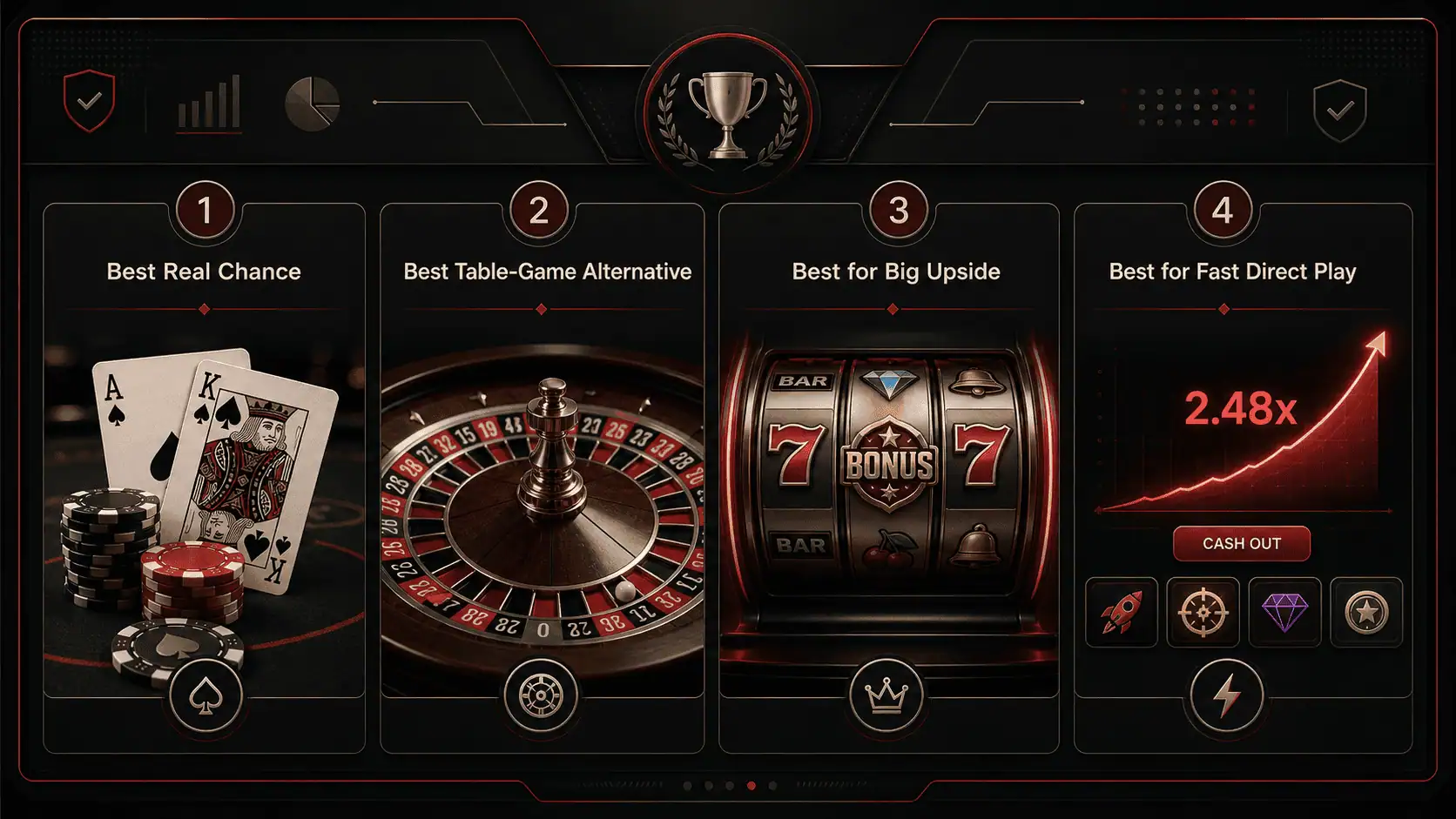
Which casino games give you the best chance to win? There is no universal winner. The answer depends on whether you mean a lower expected loss, more frequent winning bets, a chance at a very large payout, or a slower game that is easier to understand. Those are different goals, and treating them as the same question leads to misleading recommendations.
For the strongest mathematical value, compare the rules and published house edge of an individual game or bet—not the name of its category. A favourable blackjack table can offer a low house edge with correct strategy. Some digital games do, too: Stake publishes a 1% house edge for its Crash game, lower than the 2.70% of standard European roulette. That does not make Crash safer, more profitable in a short session or the right choice for every player.
This guide explains the trade-offs, shows a transparent comparison and separates expected return from win frequency, volatility and session risk. No casino game guarantees a profit, and the figures below are not the results of CasinoIndex testing. Source and rule checks: October 2026.
Best Casino Games to Win: The Short Answer by Player Goal
Start with your objective rather than a supposedly universal ranking. The table describes what to inspect, not which game will win in your next session.
| Your priority | Games worth examining | What matters most | Main limitation |
|---|---|---|---|
| Lower expected loss per amount wagered | Favourable blackjack; specific high-RTP digital games; selected table-game bets | Exact house edge, rules and strategy requirements | A low edge is not a promise of winning a session |
| More frequent winning bets | Individual even-money bets and low-multiplier formats | Probability of a winning outcome and actual payout size | Frequent small wins can coexist with negative expected return |
| Potential for a very large payout | High-volatility slots and certain multiplier games | Payout distribution, maximum win and volatility | Large prizes may be extremely rare; RTP alone cannot describe the risk |
| Clear rules and slower decisions | Roulette and selected table games | Bet type, wheel or table rules, pace and available limits | Clarity does not remove the house edge |
| Fast, interactive rounds | Crash, dice, mines and other arcade formats | Game-specific RTP, bet frequency, cashout rules and volatility | Rapid wagering can increase expected losses per hour |
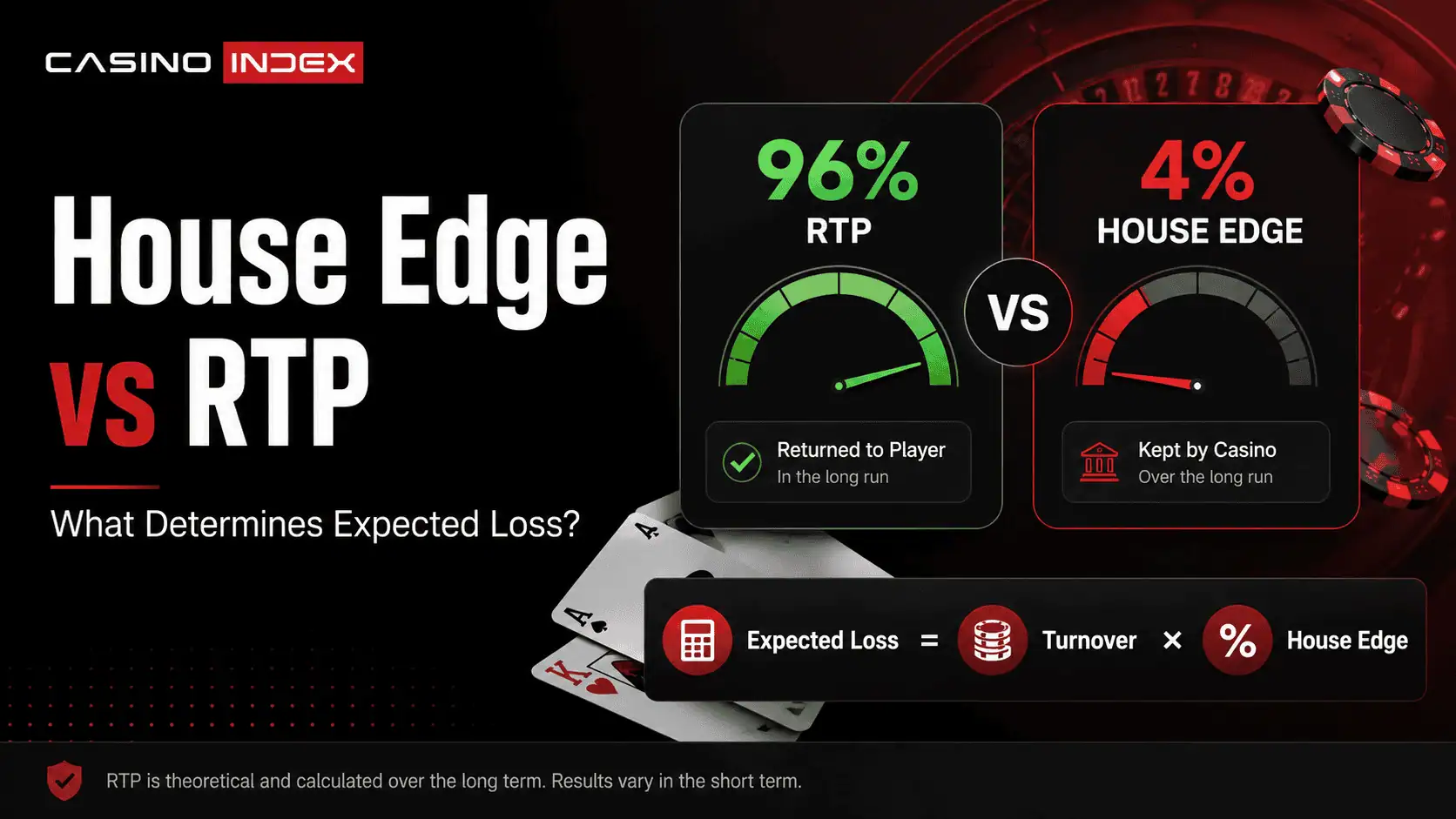
Editorial takeaway: If someone says a particular game type is always mathematically better, ask which exact game, rules and bet they used. A category label cannot supply that answer. Our house edge vs RTP explanation covers the underlying calculation.
House Edge Comparison: Specific Games Beat Broad Rankings
The most useful numerical comparison is one where the rules are known. The examples below distinguish a documented digital-game specification from roulette probabilities derived from the wheel and stated bet rules. They are not a universal ranking of all blackjack, crash, roulette or slot games.
| Game or bet | House edge | Theoretical loss per €1,000 wagered | Conditions and evidence |
|---|---|---|---|
| Stake Crash | 1.00% | €10.00 | Stake’s published 99% RTP for this specific game; other crash games may differ |
| French roulette – eligible even-money bet with La Partage | Approximately 1.35% | Approximately €13.51 | Single-zero wheel; La Partage must apply to the bet |
| European roulette – standard bet | Approximately 2.70% | Approximately €27.03 | Single-zero, 37-pocket wheel; standard payouts |
| American roulette – standard bet | Approximately 5.26% | Approximately €52.63 | Double-zero, 38-pocket wheel; standard payouts |
| Blackjack | Not one fixed figure | Depends on table rules and decisions | Payout for a natural blackjack, dealer rules, decks and playing strategy all matter |
| Slots and other arcade games | Title-specific | Cannot be stated for the category | Check the active game’s RTP information and the applicable settings |
How to read this table: The euro figures are theoretical averages calculated from the stated house edge multiplied by €1,000 of total wagers, not estimates for one person depositing €1,000. Repeatedly betting winnings increases turnover. For roulette, the figures use the exact fractions 1/74, 1/37 and 2/38, respectively. Stake’s specification comes from its official Crash game page. The UK Gambling Commission explains why RTP is a long-run average, not an individual-session forecast.
One important correction follows immediately: Stake Crash’s published 1% house edge is lower than both European roulette’s 2.70% and French roulette’s 1.35% under La Partage. It would therefore be wrong to say Crash can never rank above roulette mathematically. Equally, it would be wrong to recommend every crash game over roulette, because different crash implementations and betting conditions can have different edges and risks.
What Does “Best Casino Games to Win” Actually Mean?
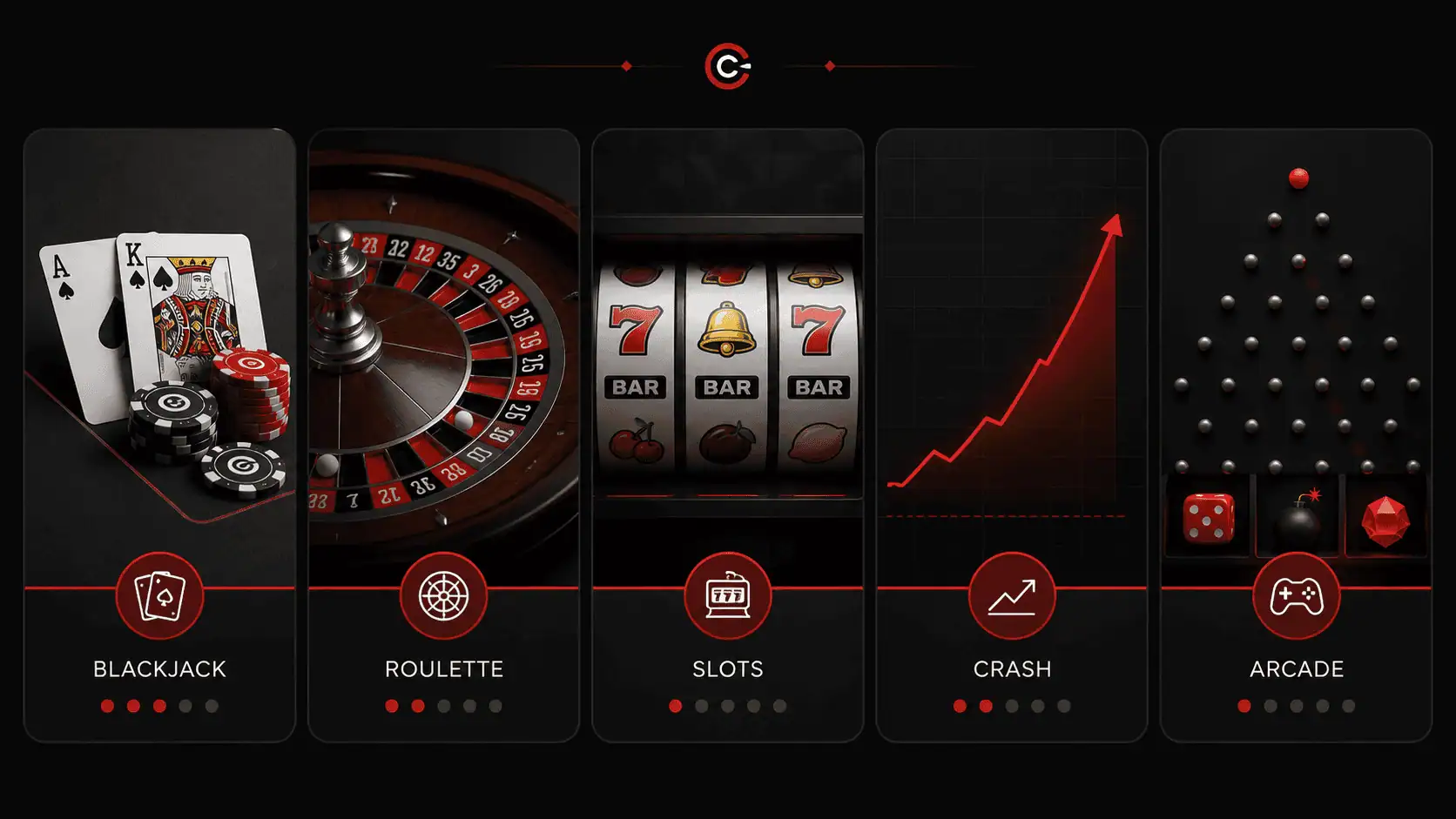
Players usually mean one of four distinct things. Identifying the difference is more useful than reading a top-ten list of games without any rules or numbers.
1. The lowest expected loss
This is the mathematical question. If a game has a 1% house edge, its theoretical average loss is €1 per €100 of total betting volume. At a 2.7% edge, it is €2.70 for the same wagering volume. Neither number predicts the outcome of a short session. They show how different rules change expected return across a large amount of play.
For this goal, the correct comparison unit is the specific game and bet. Blackjack requires a stated strategy and rule set; roulette requires a defined wheel and wager; slots and digital games require the RTP of the version actually offered.
2. Winning bets more often
A high chance of winning a single bet is not the same as a low house edge. Some bets pay small amounts frequently while a less common loss is relatively expensive. Others have a low hit frequency but pay a larger multiplier on success. Without the prize structure, win frequency alone does not reveal mathematical value.
For instance, choosing a low crash cashout multiplier generally produces more successful cashouts than waiting for a very high multiplier, but those successes are smaller. Changing the target is not a reliable way to beat the game’s embedded edge.
3. Landing a large payout
A large slot multiplier or an unusually high crash result can be memorable, but its possibility says little about the probability of reaching it. High-volatility games can feature long stretches of losses between rare large wins. Maximum advertised wins are not typical results.
4. Keeping a session easier to manage
Some players prefer games with visible choices, a clear stop point or slower rounds. Those characteristics may make the rules easier to follow, but they do not make a game mathematically profitable. Bet size and the total number of rounds still determine how much money is put at risk.
Blackjack: Strong Player Influence, but Only Under the Right Rules
Blackjack deserves attention because player decisions affect the long-run outcome. Unlike a slot spin or a predetermined crash point, a blackjack player can change the expected return by choosing when to hit, stand, double or split. Correct basic strategy aims to minimise the disadvantage imposed by the table rules.
The catch is that there is no single universal blackjack house edge. The number of decks, whether a natural blackjack pays 3:2 or 6:5, the dealer’s soft-17 rule, surrender options and restrictions on doubling or splitting can all change the calculation. A table that looks familiar may offer materially worse value than another version.
A player who does not know the appropriate strategy can also make the expected return worse. That is why stating that blackjack is always the mathematically best casino game is too broad. Favourable blackjack rules and disciplined decision-making can make it competitive, but comparisons should still use actual figures.
What to check before choosing blackjack
- Natural blackjack payout: Check whether it is 3:2 rather than assuming every table uses the same payout.
- Dealer rules: Note whether the dealer hits or stands on soft 17 and what happens to split hands.
- Allowed decisions: Doubling, surrender and re-splitting restrictions matter.
- Basic strategy: A game with skill-sensitive choices requires more than knowing the hand values.
- Side bets: Evaluate those independently rather than assuming the main game’s favourable edge applies.
Verdict: Blackjack is a strong option for players who want to understand and influence their decisions. Its mathematical ranking depends on the actual table; it does not automatically beat a digital game with a documented 1% house edge.
Roulette: Transparent Probabilities, Very Different Costs
Roulette is relatively straightforward to compare because standard wheel layouts and payouts make the core disadvantage visible. A European wheel has 37 pockets, numbered 0 to 36. A standard American wheel has 38, adding 00. That extra zero raises the house edge on ordinary roulette bets.
French roulette can offer a meaningful improvement when La Partage applies. On eligible even-money bets, a zero outcome returns half the stake instead of losing the whole amount. The effective house edge on those bets is approximately 1.35%, compared with 2.70% for conventional European roulette. This reduction does not apply to every French roulette wager or every table advertised as French.
Does roulette give you the best chance to win?
It depends on the question. For someone who wants easily explained probabilities, roulette is useful. For someone who wants a low expected loss, a La Partage bet improves the mathematics compared with standard European roulette. However, a specific game such as Stake Crash can have a lower published house edge. Roulette is not automatically second-best just because it is a classic table game.
Roulette also offers bets with different hit probabilities. A straight-up number can pay substantially more than red/black when it wins, but it lands much less frequently. On the same conventional wheel, changing the bet does not automatically eliminate the built-in house edge.
Verdict: Prefer the rules you can verify. If comparing roulette alone, a single-zero wheel is preferable to a standard double-zero wheel on house-edge grounds, and La Partage can improve eligible even-money bets further.
Crash Games: A Low House Edge Is Possible, but Speed Changes the Risk
Crash games combine a rising multiplier with a cashout decision. A player places a bet before the round and must cash out before the multiplier crashes. Once the crash has occurred, a bet that was not cashed out is lost. The visible cashout decision can feel strategic, but it does not give the player a way to predict an independently generated crash point.
CasinoIndex previously treated crash games as categorically weaker than good blackjack or roulette variants when mathematical value was the goal. That claim was too broad. Stake publishes a 99% RTP (1% house edge) for its particular Crash game. At equal total wagering volume, that is a lower theoretical expected loss than standard European roulette or French La Partage roulette.
Compare the published house edge of the specific game and bet; category alone does not determine expected return. Not every crash game shares Stake’s rules or RTP, and the published figure does not guarantee an outcome for a particular player.
Why cashout targets do not remove the edge
A lower cashout target can produce smaller successful payouts more often. A higher target can produce larger payouts less often. That trade-off affects the distribution of results; it should not be confused with proof that a chosen target makes the game profitable. A streak of successful low-target rounds can still end with losses large enough to outweigh them.
Why fast rounds deserve separate caution
Expected loss is tied to total wagering volume. A player betting €1 on 1,000 rounds has wagered €1,000 even if the initial deposit was far smaller. At a 1% house edge, the theoretical loss on that volume is €10. A slower game with a 2.7% edge but only €200 of turnover has an approximate theoretical loss of €5.41. These are hypothetical comparisons, not performance forecasts.
That is why a lower house edge does not necessarily mean a lower expected loss per hour. Rapid rounds, automatic betting and increases in stake size can outweigh the advantage of a smaller percentage edge.
Verdict: Some crash games can be mathematically competitive. Verify the exact RTP, avoid treating the cashout control as prediction skill, and consider bet frequency and volatility separately.
Arcade Games: Compare Titles, Not the Label
Arcade-style casino games cover several different mechanics, including dice, mines, limbo, plinko and other fast multiplier formats. They often have short rounds and clear on-screen actions, but those shared presentation features do not imply a shared RTP or house edge.
One arcade title can publish a different theoretical return from another. The number of decisions a player appears to make also does not tell you how outcomes are determined. In mines-type games, for example, the chance of continuing successfully changes with the number of unrevealed hazards and the rules of the selected version. In plinko-style games, the payout table and chosen risk setting matter.
Before making any claims about value, check the official game information, relevant RTP setting, maximum win, bonus or fee mechanics and whether independent verification is available. An explanation of what provably fair actually proves is useful here: verification of a random outcome does not make the game profitable or guarantee that the casino will pay.
Verdict: Some arcade games may offer competitive published returns, but broad statements such as “arcade games have poor odds” or “they are easy to win” are not supported without title-level evidence.
Slots: Big Win Potential Is Different From Favourable Odds
Slots remain central to searches for the “best casino games to win” because many players mean the chance of triggering a memorable bonus round or high multiplier. That is a question about payout potential and volatility, not necessarily the lowest average cost of play.
A slot with higher volatility may distribute much of its theoretical return through infrequent, relatively large wins. A lower-volatility title may pay smaller prizes more often. Even where two versions publish the same RTP, their experiences can differ dramatically. That is why RTP and volatility need to be assessed separately.
Another important distinction is that the same branded slot can sometimes be offered with different RTP settings. Do not rely on a title’s reputation or a percentage quoted by another site. Read the actual version’s information or paytable, where provided.
Four familiar slots—and what to compare
Gates of Olympus: A useful example of a multiplier-oriented slot. Check the active RTP and whether a particular feature or purchase option alters the way the game is played. The presence of a large potential multiplier is not evidence of a favourable hit rate.
Sugar Rush: Its cluster-style play and multiplier features can be attractive to players searching for high upside. Focus on the current game version, RTP and volatility, not only screenshots of past large wins.
Book of Dead: A recognisable bonus-round format. Compare its documented rules and paytable; the possibility of a strong feature result says little about the chance of ending a session ahead.
Sweet Bonanza: Another bonus-focused slot where a visually dramatic feature may distort perceptions of normal outcomes. Check the applicable RTP, feature terms and betting options in the live game.
CasinoIndex does not assign a fixed mathematical order to those four titles here because that would require comparing verified, currently active RTP configurations and payout distributions for the exact versions available to the reader. Browse the broader slot games guide for the underlying mechanics instead of treating a maximum-win graphic as an odds ranking.
What makes a slot comparison useful?
- Verified RTP for the specific version offered by the casino.
- Volatility and the distribution of prizes, not just average return.
- Maximum win and whether it includes rare bonus outcomes.
- Relevant feature-buy rules, stake changes and any separate game modes.
- Casino-level limitations that can affect withdrawals of winnings.
Verdict: Slots can offer substantial upside, but no slot category should automatically rank above or below blackjack, roulette or crash on mathematical grounds. The exact active game matters.
What Players Often Misread About RTP, Win Frequency and Variance
“99% RTP means I will get €99 back from a €100 session”
No. A 99% RTP describes a theoretical long-run proportion of wagering returned as prizes across many outcomes, under the specified rules. One person can lose an entire session budget; another can win much more than they staked. Short-run results fluctuate, sometimes dramatically. The Casino RTP Guide explains the principle in more detail.
“My bets win often, so this must have better odds”
Not necessarily. Hit rate and expected return measure different properties. A bet might win 80% of the time but return so little on success that the 20% of losses still make it an unfavourable wager. Examine the payout ratio alongside the outcome probability.
“A provably fair game must be a good-value game”
Provably fair systems can help verify aspects of a published random-outcome process. They do not, on their own, reveal whether a game has a low house edge, whether the operator applies fair account terms or whether withdrawals are reliable. Those are separate questions.
“More rounds let me recover the house edge”
More wagering does not make a negative expected-value game positive. In the long run, the casino’s mathematical edge becomes more consequential relative to the amount wagered. High-speed and automated betting can increase total exposure even when every individual bet is small.
“A bigger maximum win means a better game”
A maximum payout describes the top possible outcome, not its likelihood. Some very high maximum wins may be exceptionally rare. To assess a game fairly, consider both the payout distribution and the expected return.
How to Compare Casino Games Without Getting Misled
Rather than copying a universal ranking, use a consistent process for the particular version you can actually access.
- Identify your question. Are you looking for the lowest theoretical loss, a high probability of a small winning bet, large payout potential or a particular pace of play?
- Read the actual game rules. Record any important table conditions, paytable features, side bets or different modes.
- Find the relevant RTP or house edge. Use the number that belongs to that version and bet. If it cannot be verified, do not assign one.
- Check volatility or win distribution. Two games can have similar RTP figures but very different results over a short session.
- Consider wagering speed. Look at how many rounds you may play and the total amount at stake—not merely the smallest possible bet.
- Separate game math from casino trust. A good RTP does not excuse restrictive bonus terms, weak licensing disclosures or poor withdrawal handling.
- Choose a hard spending limit—or do not play. A game with a relatively low house edge still has a negative mathematical expectation under ordinary casino conditions.
Check the version rather than relying on a third-party headline. CasinoIndex also explains how to distinguish documented RTP from misleading RTP claims. Remember that availability and legality vary by jurisdiction, and game listings on international websites may not reflect what is lawful where you live.
Which Casino Games Are Best for Different Players?
If you care most about theoretical value
Compare actual house edges. A favourable blackjack variant may be competitive when played with appropriate strategy. Certain digital games publish similarly attractive or lower edges. For example, the published 1% edge for Stake Crash is more favourable per equal wagering volume than standard single-zero roulette. That says nothing by itself about the player’s likely result today.
If you prefer clearly understandable probabilities
Roulette can make a good educational starting point because wheel composition and conventional payouts are easy to calculate. Look for the exact variant. A standard American roulette wheel is materially worse in house-edge terms than standard European roulette, while La Partage offers a narrower, bet-specific improvement.
If a large possible payout matters most
High-volatility slots and some multiplier games may be more relevant to your interests. But the possibility of an exceptional win should never be described as a strong likelihood of achieving it. Treat maximum-win claims as an upper limit, not a forecast.
If you prefer active, fast rounds
Crash and arcade titles can provide direct decisions and rapid feedback. These features do not guarantee better value or control over random outcomes. The total money wagered can accumulate rapidly in a short period, particularly with autoplay.
Frequently Asked Questions
Which casino game has the best odds of winning?
There is no single correct answer without naming the exact game and bet. For expected return, compare verified RTP or house-edge figures and applicable rules. For the probability of winning an individual bet, compare the outcome probability and payout; that is a different measure.
Is blackjack better than roulette?
Favourable blackjack tables played with correct strategy can have a lower house edge than many roulette bets, but blackjack rules and player decisions matter. Roulette’s house edge also changes by wheel variant and whether special rules such as La Partage apply.
Can Crash have better odds than roulette?
Yes, depending on the specific games compared. Stake publishes a 1% house edge for its Crash game, which is lower than the 2.70% of standard European roulette and the 1.35% of eligible French La Partage bets. That does not establish that every crash title is better, or that Crash offers safer sessions.
Does a 99% RTP mean I will win 99% of rounds?
No. RTP describes theoretical value returned as prizes relative to wagering over a large sample. It is not the probability that any single round wins, and it does not promise that one player will recover 99% of their deposit.
Do high-volatility slots have better payouts?
They may offer rarer but larger possible wins; that does not mean they have a higher RTP or better expected value. Compare the actual payout distribution, volatility and RTP of the specified slot version.
Can any casino strategy guarantee a win?
No legitimate strategy guarantees a profit. Correct blackjack decisions can reduce disadvantage under suitable rules, but most casino games retain a house edge. Betting systems do not eliminate an underlying negative expectation.
Final Verdict: Compare the Game, Not the Category
The best casino games to win cannot be ranked reliably by category alone. Blackjack can reward informed decisions, roulette offers transparent probabilities, Crash and arcade titles differ widely by implementation, and slots can offer large but infrequent payouts. What counts as “best” depends on the question and the exact rules.
For mathematical comparisons, start with the published house edge of the specific game and bet. For everyday decisions, also consider how frequently a bet pays, the size of possible losses and wins, the rate of wagering, the terms of the casino and whether the game is legal in your location. A lower percentage edge does not make a session safe or turn gambling into a reliable way to earn money.
If play stops being enjoyable or limits become difficult to keep, stopping is more important than finding a marginally higher RTP. See CasinoIndex’s responsible gambling guide for practical safeguards and support options.

Talha Aydin has been active in cryptocurrency since 2017 and is a co-founder of Freecoins24 and CryptoMutant. Over the years, he has worked with crypto projects on community growth, giveaways, user acquisition and digital strategy while gaining hands-on experience across blockchain platforms and crypto markets. At CasinoIndex, Talha focuses on crypto casinos, withdrawals, payment systems, platform trust and the risks players face when moving funds between wallets and gambling platforms.