Stake vs Shuffle: Which Crypto Casino Actually Delivers Real Value?
Article OverviewStake vs Shuffle compares two crypto casinos on trust, withdrawals, KYC, rewards and usability. Stake leads CasinoIndex's ratings (9.2/10 vs 8.5/10), but neither casino has a proven advantage in large withdrawals. Shuffle's terms also address identity verification before the first cashout.
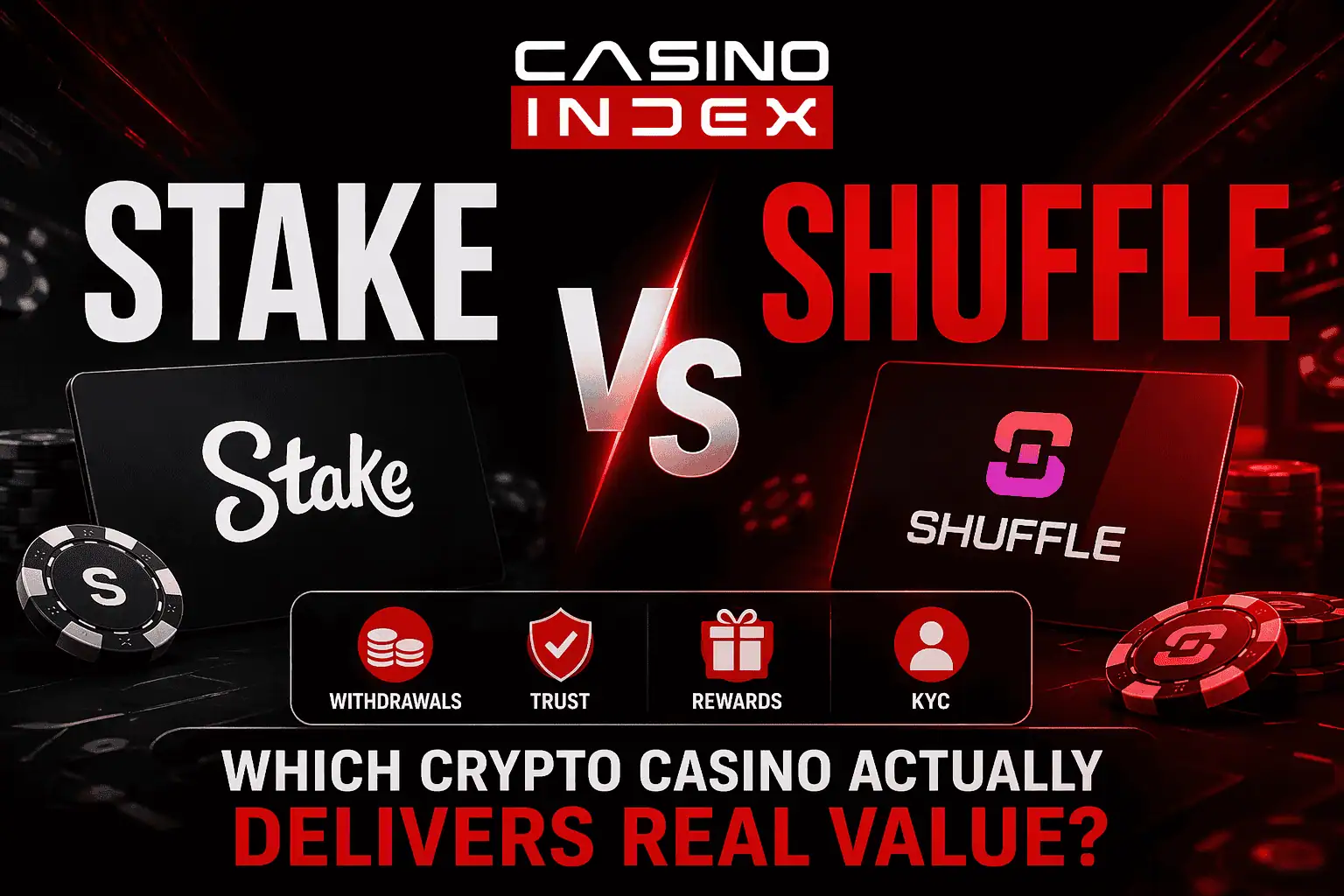
Stake vs Shuffle 2026: Which Crypto Casino Is Better?
Stake is the higher-rated casino in this comparison, with a current CasinoIndex score of 9.2/10 versus Shuffle’s 8.5/10. Stake also has a longer operating history. However, neither its rating nor its size proves that it holds greater available withdrawal reserves or processes large payouts more reliably.
Shuffle offers a modern crypto casino and sportsbook with an extensive VIP system, recurring rewards and a focused interface. Its shorter public track record deserves consideration, but that does not establish that its withdrawals perform worse.
For players comparing Stake vs Shuffle, the most useful questions concern operator trust, KYC requirements, withdrawal approval, bonus conditions and product fit.
One particularly important difference from the older comparison is Shuffle’s published verification policy. Section 5.2 of its Terms of Service expressly provides for a government-issued identity-document check before the first withdrawal. Players should not treat an easy registration process as a promise of KYC-free cashouts.
Quick answer: Stake remains CasinoIndex’s overall editorial pick based on its current rating and broader assessment. Shuffle remains a credible product alternative for users who prefer its features and rewards. Neither casino has a proven advantage in large-withdrawal success rates based on the comparative data available to CasinoIndex.
Stake vs Shuffle: Quick Comparison
The comparison below separates documented characteristics from conclusions that would require independent payment testing.
| Comparison Factor | Stake | Shuffle |
|---|---|---|
| CasinoIndex overall score | 9.2/10 | 8.5/10 |
| Operating history | Longer-established crypto casino brand. | Newer operator with a shorter public history. |
| Product offering | Broad casino, Originals, sportsbook and VIP ecosystem. | Crypto casino, Originals, sportsbook and VIP rewards. |
| Reward structure | VIP progression, rakeback, reloads and activity-based bonuses. | VIP progression, rakeback, daily, weekly, monthly and reload rewards. |
| Identity verification | KYC and additional account checks may apply under its policies. | Terms §5.2 expressly address government-ID checks before the first withdrawal. |
| Large withdrawals | Official help documentation says larger requests may require manual processing. | Verification and transaction reviews may affect approval. |
| Verified payout advantage | No comparative reserve or payout-success benchmark established. | No comparative reserve or payout-success benchmark established. |
| Full CasinoIndex review | Read Stake Review → | Read Shuffle Review → |
Editorial takeaway: Stake leads on CasinoIndex’s overall rating and operating history. Shuffle remains competitive in casino functionality and loyalty rewards. The evidence does not support assigning either operator a verified advantage in high-value payout capacity.
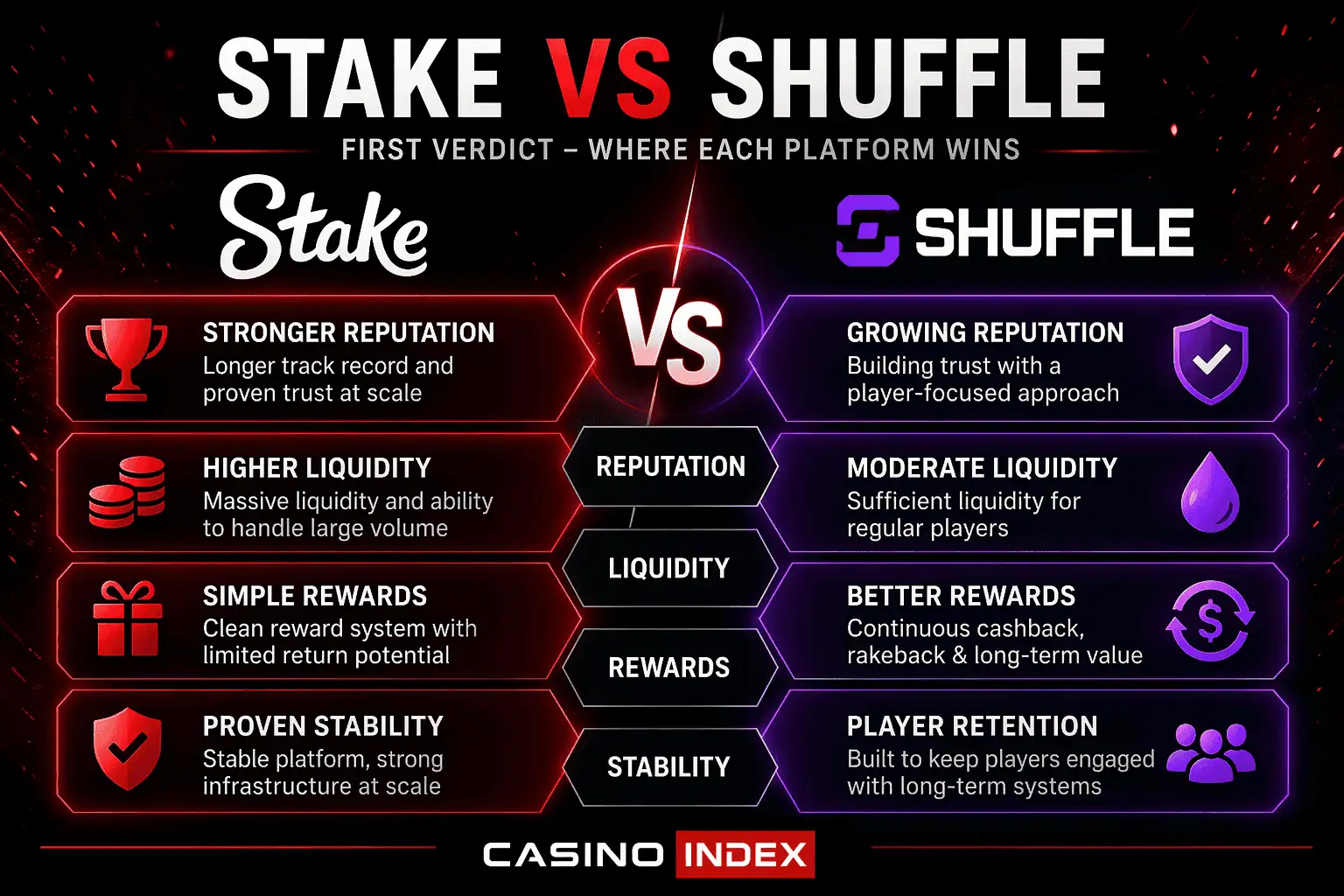
Illustration note: This comparison graphic is editorial. It does not represent independently verified casino reserves, payout-success rates or high-value withdrawal tests.
Why Stake Ranks Higher Overall on CasinoIndex
Stake currently receives an overall CasinoIndex rating of 9.2/10, compared with Shuffle’s 8.5/10.
These ratings reflect broader editorial assessments rather than a single characteristic such as traffic, game selection or promotional generosity.
Stake has operated for longer and offers a substantial casino and sportsbook product. Its longer public history also gives readers more historical material to examine.
However, public visibility is not the same as independent financial verification. A popular casino may still impose withdrawal restrictions, request identity documents or experience payment disputes.
Therefore, Stake’s higher overall rating should not be interpreted as evidence that it holds deeper liquid reserves or automatically approves larger cashouts.
What Stake’s Longer History Can Tell Us
A longer operating history gives reviewers more opportunities to examine changes in ownership disclosures, payment policies, complaint handling and platform development.
Nevertheless, historical longevity cannot establish how a specific withdrawal will perform today.
A meaningful trust assessment also needs current legal documents, withdrawal terms and documented complaint outcomes. CasinoIndex applies that distinction in its casino evaluation methodology.
Where Shuffle Remains Competitive
Shuffle combines casino games, live dealer products, Originals, sports betting and an active VIP system.
Its interface and reward organisation may suit players who prefer a different crypto casino experience. Moreover, its official help centre provides information about rakeback, VIP levels and recurring bonuses.
Still, a polished product does not establish payout reliability. Shuffle’s shorter history calls for careful evaluation of account rules and independently documented outcomes rather than an automatic negative judgment.
Stake vs Shuffle Withdrawals: Which Is More Reliable?
CasinoIndex cannot establish a statistically reliable withdrawal winner between Stake and Shuffle.
Both casinos offer cryptocurrency withdrawals. However, blockchain settlement speed and operator approval speed are separate parts of the payment process.
A transaction may reach the blockchain quickly after approval while the casino takes additional time to review an account or payment request.
To compare actual reliability, reviewers would need sufficiently detailed transaction records covering comparable currencies, withdrawal amounts, identity-verification status and player circumstances.
Such a matched dataset is not available for this comparison.
Stake Withdrawal Rules and Manual Processing
Stake’s official Help Center acknowledges that larger cryptocurrency withdrawal amounts may require manual processing by administrators.
Consequently, a higher-value withdrawal can encounter a temporary hold even when the player uses a supported cryptocurrency.
Stake also explains that blockchain confirmation requirements differ across networks. In addition, certain account-security processes may affect withdrawal requests.
These published procedures provide useful evidence about how the casino handles withdrawals. However, they do not establish an average large-payout approval time or prove that Stake performs better than Shuffle.
See the operator’s official cryptocurrency withdrawal guidance.
Shuffle Withdrawal Rules
Shuffle’s Terms of Service set conditions for withdrawing funds.
Under §10.1, the operator may refuse a withdrawal until it has verified the account holder’s identity, confirmed payment ownership and received any reasonably requested information.
Furthermore, §10.2 generally requires wagering the full value of a deposit before withdrawing funds attributable to that deposit. The clause provides an exception for a digital-asset withdrawal to the same wallet address on the same network as the corresponding deposit.
Shuffle also reserves the right to investigate account activity under §10.4 and restrict transactions when it identifies relevant compliance concerns.
Importantly, these are documented account and payment conditions. They should replace vague claims that Shuffle operates with a lighter or less restrictive withdrawal process.
Readers can check the original clauses in the Shuffle Terms of Service.
Can We Compare Withdrawal Reserves?
No verified reserve comparison supports the original article’s claim that Stake has deeper available withdrawal liquidity.
Casino traffic, brand recognition and operating history do not disclose the amount of unrestricted capital that an operator can use to satisfy player withdrawals.
Likewise, the ability to process cryptocurrency transactions does not independently demonstrate available reserves or guarantee immediate payment approval.
Therefore, CasinoIndex does not assign Stake a large-withdrawal advantage based on presumed liquidity.
KYC: Shuffle’s First-Withdrawal Rule Matters
One of the most important corrections concerns Shuffle’s identity-verification requirements.
The older comparison mainly described verification as something that might occur later if a player reached certain thresholds or triggered additional reviews.
However, Shuffle’s published Terms of Service are more specific.
What Shuffle Terms §5.2 Actually Says
Section 5.2 expressly provides for a valid government-issued identity-document check before the first withdrawal, as well as checks when a player reaches operator-defined thresholds.
Acceptable examples include a passport, national identity card or driver’s licence.
The clause also permits secondary verification methods, such as electronic checks, payment-instrument validation and selfie verification.
As a result, players should prepare for identity verification before their first Shuffle withdrawal instead of assuming they can always withdraw without documents.
Section 10.1 reinforces the importance of verification because Shuffle may withhold payment until the relevant account and payment checks are complete.
Shuffle’s help centre separately describes Level 2 identity verification and Level 3 address verification. Additional requirements can therefore arise depending on the account and compliance circumstances.
These provisions matter more than the convenience of registering an account without immediately uploading identification.
Stake KYC and Payment Checks
Stake can also request identity and account information under its policies.
Its withdrawal support documentation describes certain payment-security steps, while larger requests may require manual processing.
However, the available public evidence does not establish that Stake requires fewer checks overall or that its internal verification triggers are more predictable than Shuffle’s.
Players should consult the current verification requirements and ensure their account information is accurate before attempting withdrawals.
Withdrawal and KYC Risks: What the Evidence Supports
The following table explains the difference between documented rules and unsupported assumptions.
| Issue | Documented Evidence | What We Cannot Conclude |
|---|---|---|
| Stake large withdrawals | Stake says larger requests may require manual processing. | Stake always pays large balances faster or with fewer interruptions. |
| Shuffle first withdrawal | Terms §5.2 expressly provide for an ID check before the first withdrawal. | Easy registration guarantees a verification-free first cashout. |
| Shuffle account restrictions | Terms §10.1 and §10.4 permit payment checks and account investigations. | Every Shuffle withdrawal is automatic or always requires a manual investigation. |
| Casino liquidity | No comparable, independently verified available-reserve figures established here. | Stake has greater immediately available payout reserves. |
| CasinoIndex ratings | Stake 9.2/10; Shuffle 8.5/10. | The higher rating proves a measured large-withdrawal success advantage. |
For additional context, read why casino withdrawals can be delayed.
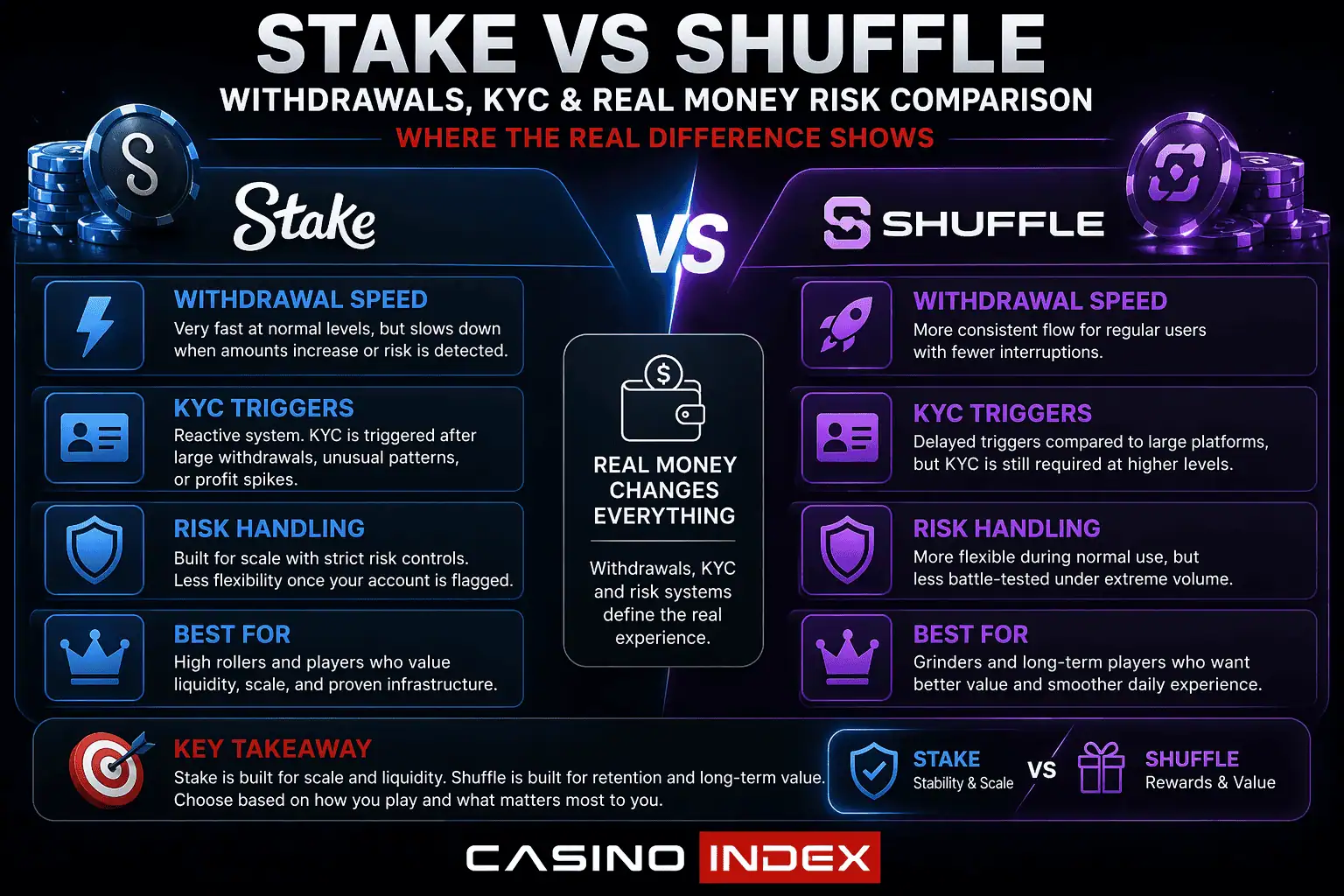
Illustration note: The graphic is explanatory and does not represent verified internal KYC algorithms, casino reserves or comparative transaction measurements.
Rewards and VIP Benefits: Stake vs Shuffle
Both casinos provide ongoing rewards. However, promotional variety should not outweigh withdrawal rules, account security or the real availability of funds.
Stake VIP Rewards
Stake offers a broad loyalty structure with VIP progression, rakeback, reloads and activity-related benefits.
The value available to an individual player depends on the relevant programme, eligibility requirements and account history.
For example, a recurring reward may look attractive but does not remove the house edge or guarantee a profitable session.
Players should also distinguish between ordinary casino balances and funds subject to promotional conditions.
Shuffle VIP and Rakeback
Shuffle’s official VIP programme includes more than 50 progression levels, with eligibility-based benefits such as rakeback, daily rewards, weekly and monthly bonuses, reloads and higher-tier VIP services.
Its official rakeback explanation describes a return based on a percentage of the game’s house edge.
For illustration, Shuffle explains that $1,000 in wagers on a game with a 2% house edge would produce $1 in rakeback at a 5% house-edge return rate.
This example demonstrates why players should not interpret a 5% rakeback rate as a guaranteed return of 5% of their total betting volume.
In addition, certain VIP rewards depend on wagering milestones or scheduled claims. Some reload rewards can expire if the player misses the claim window.
These details appear in Shuffle’s official VIP programme documentation.
Which Casino Offers Better Reward Value?
That depends on the particular reward and the player’s eligibility.
Shuffle may appeal to users who prefer its VIP interface and recurring claim structure. Meanwhile, Stake provides its own extensive loyalty programme.
However, neither platform guarantees a better net gambling outcome through rakeback or VIP benefits.
For a meaningful comparison, players should consider the reward calculation, eligibility thresholds, wagering conditions and whether the credited value is immediately available.
Bonuses vs Real Player Value
A large welcome bonus does not automatically make one casino the better choice.
For example, a deposit match can create substantial wagering requirements before a player may withdraw bonus-related funds.
Consequently, the headline amount can differ significantly from the value a typical player can realistically access.
Players should review the applicable promotion for maximum-bet limits, game restrictions, wagering contribution rules and bonus expiry.
Stake and Shuffle can change promotions over time. Therefore, this comparison does not assume that one advertised campaign remains available to every player or jurisdiction.
Our casino bonus guide explains why wagering rules and withdrawal restrictions can matter more than the advertised percentage.
Product Experience: Broader Choice or Focused Navigation?
Stake’s Product Appeal
Stake combines a substantial casino product with Originals, sports betting and loyalty features.
Its established brand and broad offering may appeal to users who want several types of gambling entertainment within one account.
However, offering more products is not a safety guarantee. Players must still review the account and payment rules that apply to them.
Shuffle’s Product Appeal
Shuffle provides a modern casino and sportsbook environment with Originals, promotions and an active VIP system.
Some players may prefer the way Shuffle organises its rewards and account features.
Nevertheless, an interface that feels straightforward does not establish shorter KYC reviews, lower payout risk or better financial outcomes.
Product preference and payment reliability are separate evaluation categories.
Reputation and Public Player Evidence
Stake has a longer operating history than Shuffle. As a result, readers have more years of publicly available material to examine.
However, larger visibility can also produce more public complaints. Without accounting for differences in player populations and reporting behaviour, raw complaint counts do not establish comparative reliability.
CasinoIndex examines specific allegations, available documents, operator responses and final outcomes rather than treating isolated reports as proof of widespread misconduct.
The same standards apply to Shuffle. A newer operating history does not establish an inability to pay, while positive withdrawal testimonials do not prove consistently successful payments.
For a trust-focused decision, the most useful evidence concerns current legal disclosures, actual account rules and well-documented dispute outcomes.
Which Casino Is Better for High Rollers?
Stake has the higher CasinoIndex overall rating and a longer operating history. However, that does not establish superior high-value withdrawal capacity.
High-balance players face additional questions that ordinary product comparisons cannot answer.
For instance, they may need to consider payment limits, the operator’s approval process, source-of-funds requests and the possibility of manual reviews.
Stake expressly acknowledges that larger cryptocurrency withdrawals may require administrator processing. Therefore, its size should not be used to promise smoother large cash

Nina Kanu has worked in cryptocurrency content and blockchain research since 2016. She is also known within parts of the crypto community through CryptoMutant, where her work has covered emerging projects, market trends and developments across the blockchain ecosystem. At CasinoIndex, Nina focuses on crypto casino reviews, platform comparisons, player experience, game ecosystems and bonus fairness. Her research examines how casino products perform beyond their marketing, including usability, payment options, promotional terms and the overall experience players receive after signing up.